

A root canal has a bit of a reputation problem. Most people searching for the best dentist for root canal in Kasba aren’t looking for reassurance so much as straight answers: why does this tooth hurt so much, what actually happens during root canal treatment in Kasba, and how do you pick a dentist you can trust with it. This guide covers all of that without the exaggerated claims some clinic pages tend to lean on.
When Do You Need a Root Canal Treatment?
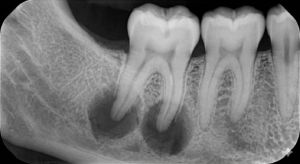
A root canal becomes necessary when the pulp inside a tooth, the soft tissue containing nerves and blood vessels, gets infected or badly inflamed. This usually shows up as a combination of the following:
- Severe or persistent toothache, especially one that lingers rather than passing quickly
- Pain while chewing or biting down, which often points to inflammation deep inside the tooth
- Sensitivity to hot or cold that stays sharp for a while after the trigger is gone, rather than fading in a few seconds
- Swollen gums around a specific tooth, sometimes tender to the touch
- A dental abscess or visible pus, which signals an active infection
- Tooth discoloration, often a sign the internal pulp has died
- Deep decay or a cracked tooth, either of which can expose the pulp to bacteria
Not every one of these symptoms means you automatically need a root canal, but any combination of them is worth getting examined by a root canal dentist in Kasba rather than waiting to see if it passes.
How Do You Choose the Best Dentist for Root Canal in Kasba?
“Best” isn’t really a title a dentist can claim for themselves, it’s something you can actually assess with a few direct questions before you commit to treatment. Choosing the best dentist for root canal in Kasba comes down to how a clinic answers these questions, not what it claims about itself.
- Check whether the dentist has endodontic expertise. A large study following nearly half a million root canal cases found survival rates of 98% at one year and 86% at ten years overall, with a modest but measurable edge for cases treated by endodontists, particularly on harder teeth. For a straightforward case, a general dentist with solid endodontic experience is often perfectly capable. For a complex molar or a repeat case, specialist training starts to matter more.
- Ask how the tooth will be diagnosed. A proper diagnosis usually involves an exam plus an X-ray to confirm which tooth is affected and how far the infection has spread, not just a quick look and a recommendation.
- Check what RCT technology is used. Rotary instruments, an apex locator, and digital imaging all affect how precisely the canals are cleaned and measured. Any RCT dentist in Kasba working with this equipment as standard is generally better placed to handle complex canals.
- Ask whether single-visit treatment is appropriate for your case. It’s a reasonable question, but the honest answer is that it depends on the tooth, not a blanket policy.
- Understand the complete treatment cost upfront, including whether a crown or other restoration is included or billed separately.
- Ask whether you’ll need a dental crown after RCT. A dentist who can explain why, based on your specific tooth, is giving you a real answer rather than an automatic upsell.
- Check the clinic’s sterilisation and infection-control practices. This is a fair question to ask directly, and any properly run clinic should be able to answer it without hesitation.
- Ask how complex or repeat root canal cases are handled, whether that’s in-house or through referral. A dentist who’s upfront about when a case needs specialist input is generally more trustworthy than one who insists every case is routine.
Is Root Canal Treatment Painful?
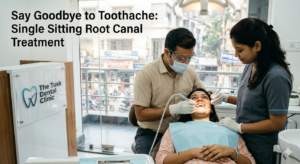
The procedure itself is done under local anaesthesia, so you shouldn’t feel sharp pain while the dentist is working on the tooth. What’s realistic to expect is some tenderness or mild discomfort for a day or two afterward, similar to what you’d feel after a deep filling, as the tissue around the tooth settles down. Research comparing single-visit and multiple-visit treatments has found success rates in the same range for both, around 85 to 93%, though single-visit treatment tends to come with slightly higher pain in the first 24 hours before levelling off. No dentist can honestly promise a completely painless experience for every patient, since pain tolerance and the severity of the original infection both play a role, but modern anaesthesia and technique make root canal treatment far more manageable than its reputation suggests.
How Much Does a Root Canal Cost in Kasba?
Root canal cost isn’t a single fixed number, and a few factors genuinely change it from case to case:
- The type of tooth (a front tooth with one canal costs less to treat than a molar with three or four)
- The number and shape of the root canals involved
- How severe the infection is
- Whether diagnostic imaging like X-rays is needed
- Whether this is a first-time treatment or a retreatment of a previously root-canaled tooth
- The type of restoration or crown placed afterward
- The materials and technology used during treatment
Because of this variation, a dentist should examine your tooth and take an X-ray before quoting a price. A number given over the phone without seeing the tooth isn’t a real estimate. The best root canal treatment in Kasba isn’t necessarily the cheapest option on offer, it’s the plan that’s actually matched to your tooth’s condition after a proper exam.
How Long Does Root Canal Treatment Take?
- Single-visit RCT completes cleaning, shaping, and filling the canal in one appointment, usually under an hour depending on the tooth.
- Multiple-visit RCT spreads the same steps across two or more appointments, sometimes with a medicated dressing placed between visits, particularly for more heavily infected teeth.
- Complex RCT, involving molars with curved or unusually shaped canals, generally takes longer regardless of whether it’s done in one visit or several.
- Retreatment of a previously root-canaled tooth that has developed a new problem takes longer still, since the old filling material has to be removed before the canal can be cleaned again.
Clinical studies comparing single- and multi-visit approaches have generally found no significant difference in long-term success between the two, so the right choice comes down to the specific tooth and how your dentist assesses it, not a fixed rule.
What Technology Is Used During Root Canal Treatment?
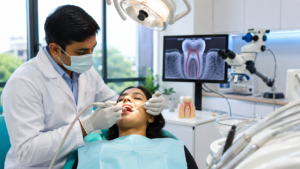
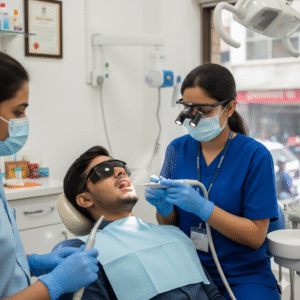
Modern root canal treatment typically involves digital X-rays for a clearer, lower-radiation view of the tooth and surrounding bone, an apex locator to measure canal length electronically rather than by estimation, and rotary or engine-driven instruments that clean and shape canals more efficiently than hand files alone. Magnification is used in some clinics for added precision on complex canals, and canal filling relies on modern sealing techniques designed to close off the space completely and reduce the chance of reinfection. None of this guarantees a particular outcome on its own, but it does reflect current standards in endodontic care.
Will I Need a Crown After Root Canal Treatment?
Often, but not automatically. A tooth that’s lost significant structure to decay or a large filling before treatment is more likely to need a crown for protection, since a root-canaled tooth without enough remaining structure is more prone to fracture under normal biting force. A front tooth with minimal decay and a small access opening may only need a filling. The right call depends on how much natural tooth is left and where the tooth sits in your bite, which is something your dentist should assess and explain rather than assume by default.
Root Canal Treatment at The Tusk Dental Clinic, Kasba
The Tusk Dental Clinic, located at 44 Rajdanga Main Road, Nabapally, Sector F, Kasba, Kolkata, has an in-house endodontist, Dr. Nayanika Singh, MDS, who handles root canal cases at the clinic. Treatment starts with a proper consultation and diagnosis rather than a quick assumption, followed by a treatment plan specific to your tooth. Patient comfort is treated as a priority throughout, sterilisation protocols are followed consistently, and restoration after the root canal, whether that’s a filling or a crown. It is planned as part of the same treatment rather than an afterthought. Follow-up care is available if anything needs to be checked once the tooth has settled.
Between an in-house endodontist, clear cost discussions, and modern equipment, this is what makes The Tusk Dental Clinic a strong option for the best dentist for root canal in Kasba. For anyone who wants a clear explanation before treatment starts rather than just a recommendation. If you’re dealing with a toothache that isn’t going away, booking a consultation is the most direct way to find out what’s actually going on.
Frequently Asked Questions
What is the cost of a root canal in Kasba?
It depends on the tooth, the number of canals, the severity of infection, and whether a crown is needed afterward. An accurate estimate requires an exam and X-ray.
Is root canal treatment painful?
The procedure itself is done under local anaesthesia. Some mild soreness for a day or two afterward is normal, though experiences vary from person to person.
Can a root canal be completed in one sitting?
Often, yes, particularly for less complex teeth. Studies show single-visit and multi-visit treatments have broadly similar success rates.
How long does a root canal treatment take?
A straightforward single-visit case can take under an hour. Multi-visit or complex cases, including retreatment, take longer.
Do I need a crown after root canal treatment?
It depends on how much natural tooth structure remains. Heavily decayed or back teeth often need a crown for long-term protection.
How do I choose a root canal dentist in Kasba?
The best dentist for root canal in Kasba is one who examines the tooth properly, explains the diagnosis clearly, and walks you through cost, technology, and aftercare before treatment starts.
What happens if a root canal infection is left untreated?
The infection can spread to the jaw and surrounding tissue and, in rare but serious cases, into the bloodstream, so it shouldn’t be ignored.
Can a badly infected tooth still be saved?
In many cases, yes, through root canal treatment, though very severe infection or structural damage may sometimes require extraction instead.
Is an endodontist better suited for complex root canal cases?
Generally yes. Endodontists see a higher volume of difficult cases and studies show somewhat lower complication rates on complex teeth compared to general dentists.
How long does a root canal-treated tooth last?
With proper restoration and care, long-term studies show survival rates of around 90% or higher at ten years, and many teeth last for decades.