
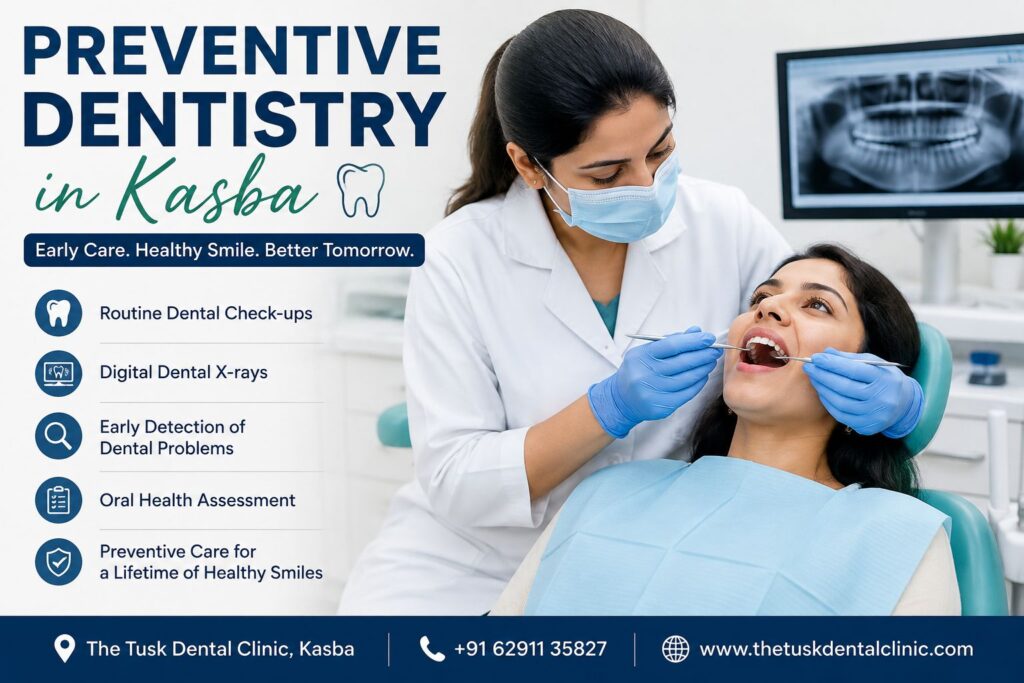
People usually pay attention to dental care only if they have problems with their teeth or something strange is happening in the mouth. And then, in most cases, it may turn out that the problem requires more serious care than just treatment. Preventive Dentistry in Kasba plays a crucial role in keeping your teeth and gums healthy and free from any problems.
Routine dental check-ups are not only a way to detect possible cavities but a method to monitor the state of your mouth, solve minor problems, and help you to maintain your teeth healthy. No matter whether you are a college student, an employee, or even a retired person, regular dental care is one of the ways to minimize the number of complicated dental operations.
In our blog, we will tell you about the importance of preventive dentistry and regular visits to the dentist’s office.
Preventive Dentistry: What Is It?
Preventive dentistry is all about maintaining the health of your teeth, gums, and mouth before any issues arise. Instead of treating dental issues, it involves regular checks, oral hygiene maintenance, and treatment of any dental issue that could potentially arise in the future.
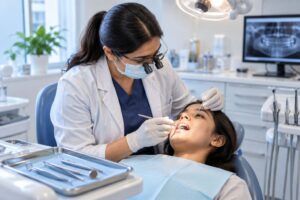
Preventive dentistry at a dental clinic typically starts with the assessment of the overall state of your oral health. During this appointment, the dentist conducts an examination of your teeth, gums, and general condition of your mouth and checks for any signs of dental issues such as decay or gum disease. If necessary, more advanced diagnostics will be recommended.
Preventive dentistry is recommended to everyone regardless of age since everyone needs healthy teeth and gums.
Here are some preventive dental procedures that you can get at a dental clinic:
- Dental exams
- Professional dental cleaning
- Assessment of oral health
- Digital dental imaging (if necessary)
- Advice on maintaining oral hygiene
- Monitoring dental issues
All of these procedures are aimed at the maintenance of the health of your teeth and reducing any potential future dental problems.
Prevention Is Better Than Cure
Dental conditions usually start quietly. A minor cavity, gingival inflammation, or plaque accumulation may not cause pain at first. But, without proper treatment, the condition may worsen over time.
There are some benefits to choosing prevention over other types of treatment:
| Preventive Care | How it Helps |
| Routine dental examination
| To detect any dental issues at an early stage
|
| Oral examination
| It helps to assess the state of your teeth and gums.
|
| Professional cleaning
| To remove any plaque and tartar that brushing cannot do.
|
| Digital dental imaging
| It helps detect any underlying dental issues when needed.
|
| Guidance on oral hygiene
| To promote good dental care habits
|
Regular visits for preventive care may actually make your dental care easier and less costly.
The Importance of Regular Dental Check-ups
Life is quite hectic, and it’s easy to put off going to the dentist until something happens to your teeth. However, dental problems usually develop gradually and may be symptomless in their initial stage.
A routine dental check-up gives your dentist a chance to monitor your oral health and detect any changes. This way, the possibility of early detection of any potential issues is assured, and treatment is made simpler, and natural teeth are maintained.
At a routine check-up, your dentist will:
- Look for any cavities and decay
- Test for gum disease
- Check for plaque and tartar formation
- Look at fillings and other restorations
- Check for your occlusion and oral health
- Refer you for additional tests if needed
Common Dental Problems That Can Be Easily Prevented
Dental issues are avoidable through adopting simple practices as well as visiting the dentist regularly. Preventive dentistry is aimed at detecting the above conditions before any discomfort results from them, and treatment becomes inevitable.
The following are some of the most common preventable dental conditions:
Tooth decay
The process of tooth decay starts as a result of the acids produced by bacteria in the mouth, damaging the enamel of the teeth. Dental check-ups make it possible to detect cavities before they become worse.
Gum disease
The health of your gums has a great impact on your teeth. In the early stages of the disease, symptoms such as reddening and swelling can easily be controlled through dental examinations.
Build-up of plaque and tartar
While you practice brushing your teeth regularly, plaque can accumulate in some parts that are difficult to reach. Plaque turns into tartar after a while, and the tartar cannot be removed through brushing. Professional cleaning prevents gum diseases.
Bad breath
Bad breath that is persistent can be associated with plaque accumulation, gum diseases, and other oral health conditions. Dental examination will help identify the reason behind the condition.
Benefits of Using a Digital Dental X-Ray to Detect Problems Early
A comprehensive dental exam helps detect many oral health issues but leaves some of the underlying problems out of sight. That is why you need a digital dental X-ray in Kasba in order to get a good idea of what is happening under your gums and bones. With such a device, your dentist will be able to see everything about your teeth, jawbones, and other areas not visible during a routine oral examination.
A digital dental X-ray in Kasba might be prescribed too:
- Identify cavities between teeth
- Check tooth roots for diseases
- Detect bone loss due to gum disease
- Check how wisdom teeth develop
- Look into infections and cysts under gums
- Plan further dental treatment
One of the key benefits of digital X-rays is their ability to provide a high-quality image in just a few seconds without significant amounts of radiation used in traditional systems.
Simple Everyday Habits That Contribute To Oral Health
Visiting a dental specialist regularly is essential when it comes to taking care of your teeth. However, the habits you have on a daily basis are equally important for preserving a healthy smile.
Some everyday activities that will help you preserve a healthy smile include:
- Brushing your teeth twice a day with fluoride toothpaste.
- Flossing every day to remove food particles and plaque from between teeth.
- Mouth rinsing after having sweet things or beverages.
- Drinking enough water during the day.
- Having a balanced diet for proper teeth and gum function.
- Replacing your toothbrush every 3 to 4 months.
Not using any tobacco products, as it increases the risks of developing gingivitis and oral cancer.
Such daily activities along with regular visits to the dentist will give you the opportunity to have healthy teeth. Even if you think that there are no issues with your mouth, regular dental check-ups will prevent them from occurring.
When Do You Need to See a Dentist?
There is a common belief among people that going to see a dentist is necessary only when one experiences a severe toothache. However, such a belief is not always true since it implies that there is a serious problem in your mouth by then.
Apart from the regular dental visits twice per year, there are other reasons for you to schedule an appointment with a dentist, including:
- Constant toothache
- Bleeding gums during brushing or flossing
- Bad breath
- Tooth sensitivity to food and drinks
- Loose teeth
- Swelling of your gums or jaw
- Broken/chipped teeth
- Hardly chewing food
Receiving professional consultations on time helps to detect possible problems in your mouth, and the dentist will offer you easier and more efficient ways to solve them.
Prevention Is the Key to Keeping Your Smile Healthy
Taking care of your teeth is not only about maintaining a good smile but also about your health in general. It could be a routine dental exam, oral health assessment, or digital dental X-rays in Kasba. Each step has its importance in detecting issues and solving them before they get complicated.
If it’s been quite some time since your last dental visit, think about scheduling a routine dental exam today. It is a simple step that will help you avoid further dental complications in the future. If you choose Preventive Dentistry in Kasba, you can rest assured that your smile is going to stay healthy and bright for many years to come.
Frequently Asked Questions (FAQs)
1. How often should I have a routine dental exam?
A routine dental exam should be done twice a year. However, if you suffer from gum disease, cavities, or any other dental problems, your dentist may require you to see him/her more frequently.
2. What is an oral health assessment?
A typical oral health assessment involves a comprehensive check of your teeth, gums, tongue, and other structures in your mouth. This checkup helps the dentist detect cavities, gum disease, plaque accumulation, misaligned bites, and other problems that might be developing.
3. Is a digital dental X-ray safe?
Yes. Digital dental X-rays at Kasba use much less radiation compared to traditional X-ray devices but provide excellent imaging quality. It is a great diagnostic tool for conditions that are invisible during a regular examination.
4. Why is early detection of dental problems necessary?
Early detection of dental problems is necessary because in this way dentists can spot any issues before they become serious. The early detection of the problem will simplify its treatment and reduce costs.
5. Can preventive dentistry be helpful for both kids and adults?
Proper oral hygiene and regular visits to the dentist will allow kids to build proper oral care habits, while adults will have strong teeth and healthy gums.