
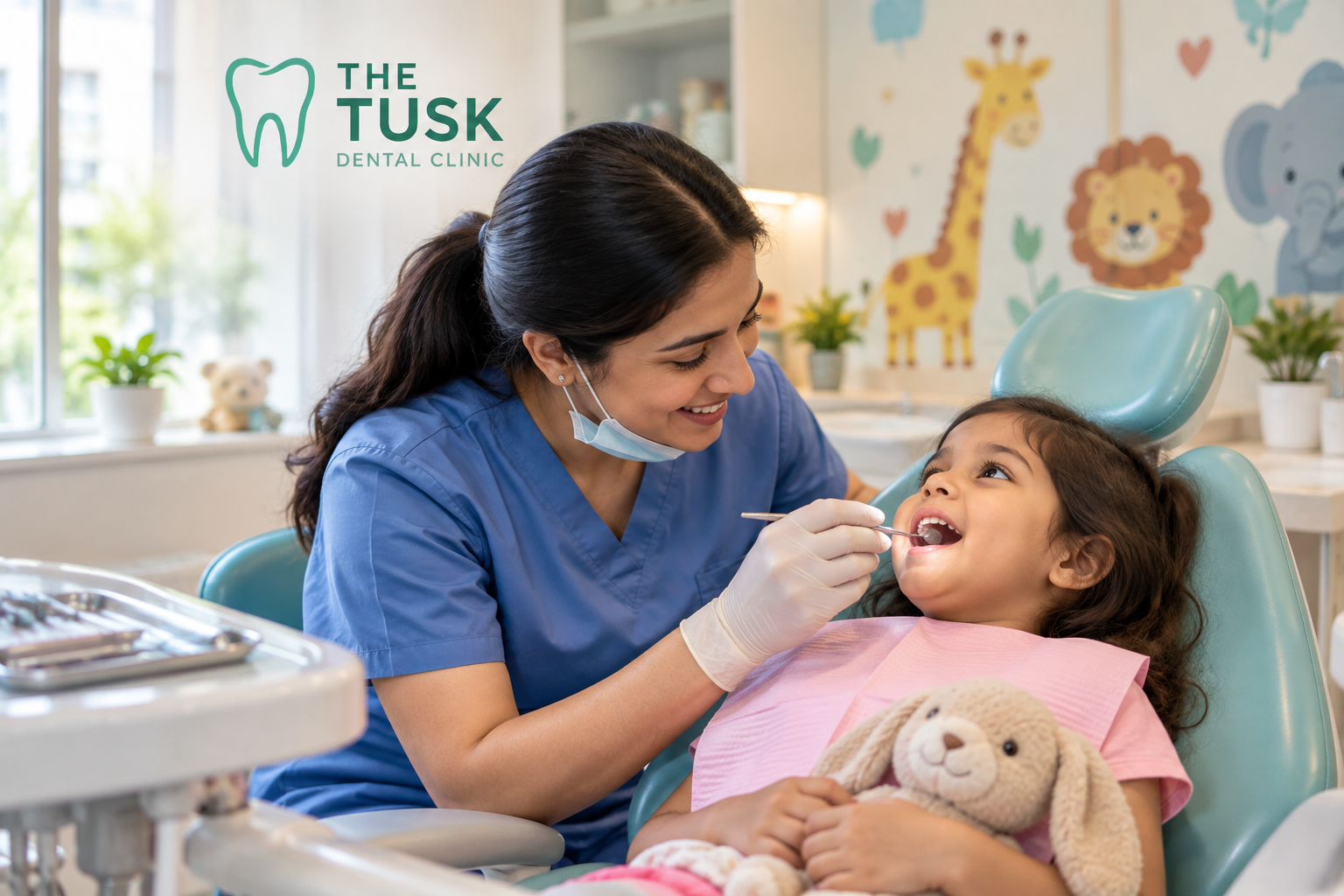
Most parents don’t think about booking a dentist for their child until something goes wrong: a sudden toothache at night, a chipped tooth after a fall, or a dark spot that wasn’t there last month. By then, treatment is usually more involved than it needed to be.
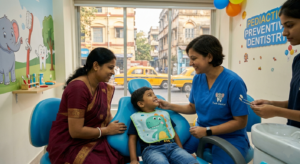
Children’s teeth develop on a fairly predictable timeline, and problems tend to show early warning signs long before they turn into an emergency. If you’re a parent and trying to figure out when your child actually needs to see a pediatric dentist, or what to do about something you’ve already noticed, this guide walks through it step by step. You can visit The Tusk Dental Clinic as it is renowned as one of the best pediatric dentist in Kasba.
When Should a Child First Visit a Pediatric Dentist?
The general recommendation from the American Academy of Pediatric Dentistry is that a child’s first dental visit should happen within six months of the first tooth coming in, or by their first birthday at the latest. That surprises a lot of parents, who assume dentist visits start once a child has a full set of teeth or starts complaining about pain.
There’s a reason for the early timing. Tooth decay can start almost as soon as teeth erupt, especially if a child is still bottle-fed at night or nursing frequently. An early visit isn’t about drilling or treatment. It’s a short, low-pressure check to look at how the teeth and gums are developing, catch anything unusual before it becomes a bigger issue, and give parents practical guidance on brushing, feeding habits, and thumb sucking.
Waiting until age three or later, which is what a lot of families still do, means a dentist is often seeing a child for the first time after a problem has already taken hold rather than before.
Why Baby Teeth Need Proper Dental Care
It’s a common assumption that baby teeth don’t matter much since they fall out anyway. In practice, they do a lot of work in the years a child has them.
Baby teeth hold the space that permanent teeth will eventually need. If a baby tooth is lost early to decay or injury, nearby teeth can drift into that gap, leaving too little room for the adult tooth and setting the stage for crowding later on. Baby teeth are also involved in chewing properly, which affects nutrition, and in forming certain sounds correctly, which affects speech development at exactly the age when a child is learning to talk.
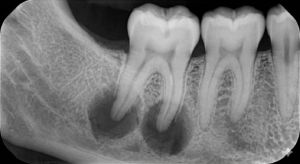
There’s also a more direct concern: decay in a baby tooth sits close to the developing permanent tooth underneath it. Left untreated, an infection in a baby molar can affect the health and appearance of the adult tooth that’s still forming below the gumline. So while the tooth itself is temporary, the consequences of neglecting it often aren’t.
7 Signs Your Child Should See a Pediatric Dentist
Not every dental visit needs to wait for the next scheduled checkup. These are the signs worth acting on sooner.
Toothache. Kids don’t always describe pain clearly. Sometimes it shows up as refusing certain foods, chewing only on one side, or being unusually cranky around mealtimes. Any complaint of tooth pain, even if it comes and goes, is worth checking rather than waiting out.
Black or brown spots. Discoloration on a tooth’s surface is often the first visible sign of decay. It doesn’t always hurt yet, which is exactly why it shouldn’t be ignored. Catching it at this stage usually means simpler, less invasive treatment.
Sensitivity. If your child winces or complains when eating something cold, hot, or sweet, it can point to enamel that’s thinning, a small cavity, or exposed dentin. It’s easy to dismiss as a phase, but it’s a genuine signal worth a dental exam.
Swollen gums. Puffy, red, or bleeding gums usually mean early gum inflammation, sometimes from plaque buildup that isn’t being brushed away effectively. In some cases, swelling near a single tooth can point to an abscess forming underneath it.
Difficulty chewing. If a child starts avoiding harder foods, chewing carefully on one side, or seems to struggle with foods they used to eat without trouble, it’s often a sign that something, a cavity, a loose tooth, or gum irritation, is bothering them.
Broken or chipped tooth. Falls and bumps are common at this age, and a chipped tooth isn’t always an emergency, but it should still be looked at. A crack that seems minor can sometimes extend closer to the nerve than it appears from the outside.
Delayed or abnormal tooth eruption. Every child’s timeline varies a little, but teeth coming in noticeably late, in an unusual order, or at an odd angle is worth a dentist’s opinion. It can be entirely normal, or it can point to a crowding issue that’s easier to manage the earlier it’s spotted.
If you are looking for a reliable pediatric dental clinic in Kasba you can visit The Tusk Dental Clinic for better results.
What Happens During Your Child’s First Dental Visit?
First visits are deliberately low-key, and for good reason: the goal is to build trust, not just check teeth.
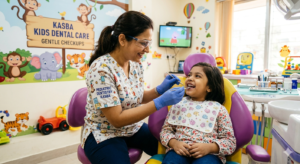
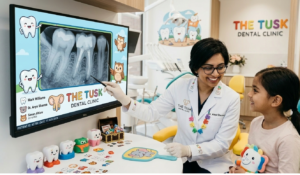
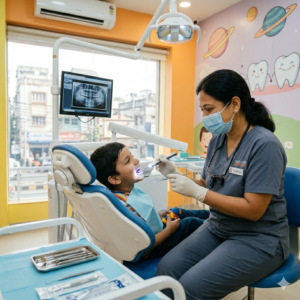
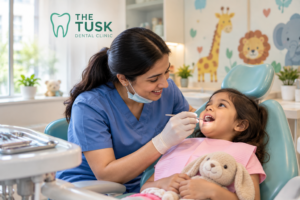
For infants and very young toddlers, the exam is often done “knee to knee,” with the child sitting on a parent’s lap facing the dentist, who gently checks the teeth and gums while explaining what they’re seeing. There’s usually no equipment involved beyond a small mirror and a light.
For slightly older children, the visit typically follows a “tell-show-do” approach: the dentist explains what a tool does, shows the child what it looks like, sometimes lets them hold or touch it, and only then uses it. This reduces anxiety and helps children understand that nothing is happening without warning.
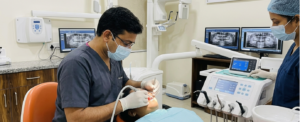
Most first visits involve looking at how teeth are erupting, checking for early decay, assessing bite alignment, and talking to parents about brushing technique, diet, and habits like thumb sucking or pacifier use. Treatment, if anything is needed, is rarely done on the very first visit unless there’s an urgent issue.
Common Dental Problems in Children
A handful of issues come up repeatedly in pediatric dentistry, and most are preventable or manageable if caught early.
Cavities. This is by far the most common issue. Research on Indian children has found early childhood caries in nearly half of children examined across studies, with a pooled prevalence around 47% in a large meta-analysis covering tens of thousands of children. Sugary snacks, frequent snacking, and inconsistent brushing are the usual drivers.
Gum problems. Gingivitis in children usually stems from plaque that hasn’t been brushed away properly, particularly along the gumline and between teeth. It’s reversible in most cases with better hygiene, but it can progress if left unchecked.
Tooth injuries. Falls, sports, and general roughhousing mean chipped, cracked, or knocked-out teeth are fairly common in childhood, particularly between the toddler years and early school age.
Crowding. When jaws are too small for the number of teeth coming in, or when a baby tooth is lost too early, teeth can come in overlapping or misaligned. This is often flagged early and monitored before deciding whether orthodontic treatment will eventually be needed.
Thumb sucking. Sucking on a thumb or pacifier is normal in infancy and usually stops on its own. It becomes a dental concern mainly when it continues well past age three or four, especially once permanent teeth start coming in around age six.
Early tooth loss. Losing a baby tooth well before its natural time, whether from decay or injury, can allow neighboring teeth to shift into the gap. This is one of the more overlooked problems, since parents often assume it’s not a big deal since “it was just a baby tooth anyway.”
How Pediatric Dentists Treat Cavities in Children
Treatment depends heavily on how advanced the decay is by the time it’s caught.
For very early lesions that haven’t fully broken through the enamel, a fluoride varnish or remineralizing treatment can sometimes stop or slow progression without any drilling at all. This is one more reason regular checkups matter: catching decay at this stage avoids more involved work later.
Once a cavity has formed, a standard filling is usually enough, similar to what’s done for adults but with materials and techniques adjusted for a child’s comfort and cooperation. If decay has reached deeper into the tooth and affected the nerve, a pulpotomy, sometimes called a “baby root canal,” removes the affected inner tissue while preserving the rest of the tooth, which is then usually capped with a stainless steel or tooth-colored crown.
In cases where a tooth is too damaged to save, extraction is the last option, typically paired with a space maintainer, a small device that holds the gap open so neighboring teeth don’t drift into it before the permanent tooth is ready to come in.
Do Children Need Fluoride Treatment and Dental Sealants?
For most children, yes, and the evidence for sealants in particular is fairly strong.
Fluoride varnish is a quick, painless application done during a regular checkup that strengthens enamel and helps resist decay. It’s especially useful for children who are more prone to cavities or who have limited access to fluoridated water.
Sealants are a thin protective coating applied to the chewing surfaces of back teeth, where deep grooves make brushing less effective at reaching every corner. According to CDC data, sealants can prevent around 80% of cavities in the first two years after application, with meaningful protection continuing for several years after that. Sealants are usually recommended once the first permanent molars erupt, typically around age six, and again for the second molars around age twelve.
What to Do If Your Child Breaks or Knocks Out a Tooth
The right response depends on whether it’s a baby tooth or a permanent one, and this distinction matters more than most parents realize.
If it’s a baby tooth: Do not try to put it back in the socket. Reinserting a baby tooth can damage the permanent tooth developing underneath it. Instead, keep your child calm, use a clean cloth or gauze to control any bleeding, and save the tooth if you can find it. Call your dentist the same day so they can check for any damage to the surrounding gum, bone, or the tooth bud below.
If it’s a permanent tooth: Time matters here. Pick the tooth up by the crown, not the root, and avoid scrubbing it. If it’s dirty, rinse it briefly with clean water. If possible, gently reinsert it into the socket and have your child bite down softly on a clean cloth to hold it in place. The chances of successfully saving a permanent tooth drop sharply after 30 to 60 minutes outside the mouth, so this is a genuine dental emergency rather than something to sit on until the next available appointment.
For a chipped or cracked tooth that hasn’t come out entirely, it’s still worth getting checked, even if your child isn’t in obvious pain. Cracks aren’t always visible on the surface, and what looks minor can sometimes run closer to the nerve than expected.
How Parents Can Prevent Cavities at Home
Most cavities in children are preventable with a handful of consistent habits rather than any single dramatic change.
Brushing twice a day with a fluoride toothpaste appropriate for your child’s age is the foundation, and it genuinely matters that an adult supervises or helps until a child has the hand coordination to brush thoroughly on their own, usually somewhere around age six or seven. Flossing should start as soon as two teeth touch each other, since a toothbrush alone can’t clean between them.
Diet plays a bigger role than most parents expect. It’s not just how much sugar a child eats, but how often. Frequent snacking or sipping on sweet drinks throughout the day keeps teeth under near-constant acid exposure, which does more damage than the same amount of sugar eaten in one sitting. Bedtime bottles filled with anything other than water are one of the most common causes of early decay in toddlers, since the sugar sits on the teeth for hours overnight.
Regular checkups round out the picture. Even with excellent habits at home, professional cleanings and exams catch things that aren’t visible to a parent, and they give a dentist the chance to apply fluoride or sealants at the right time.
How Often Should Children Visit a Pediatric Dentist?
The standard recommendation is a checkup every six months, similar to adults, and this schedule works well for most children.
That said, it’s not a fixed rule for every child. Some children have a higher risk of cavities, whether due to diet, tooth alignment, or a history of decay, and their dentist may recommend visits every three to four months instead. Others with strong home habits and low risk may be fine sticking to the standard six-month interval. Your child’s dentist is generally the best judge of what fits their specific situation, and it’s worth asking directly at each visit rather than assuming the default schedule applies.
How to Choose a Pediatric Dentist in Kasba
A few things are worth checking before settling on a dentist for your child.
Specific training in pediatric dentistry matters, since children’s teeth, behavior, and communication needs are genuinely different from adults. A dentist who works with kids regularly tends to be better equipped to manage anxiety, explain things in age-appropriate terms, and spot issues specific to developing teeth.
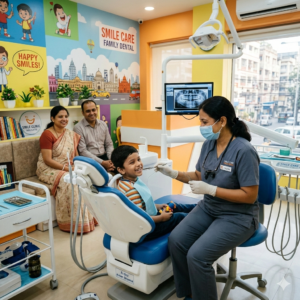
The environment itself matters too. A clinic that feels calm and unintimidating, with staff who are patient rather than rushed, makes a real difference in how a child responds to future visits, not just the first one. Ask how the practice handles a nervous or uncooperative child, since that’s a fairly common scenario and the answer says a lot about their approach.
Practical factors count as well: how easy it is to reach the clinic for a routine six-monthly visit, whether they’re equipped to handle a dental emergency outside normal hours, and whether they take the time to explain treatment options clearly rather than jumping straight to a recommendation.
Pediatric Dental Care at The Tusk Dental Clinic
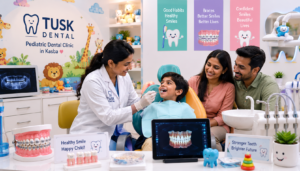
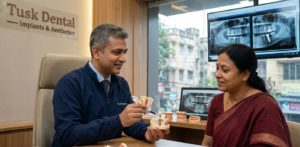
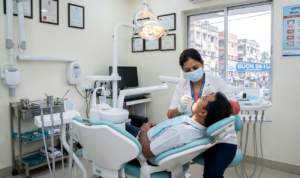
The Tusk Dental Clinic is located at 44 Rajdanga Main Road, Sector F, Nabapally, Kasba, Kolkata, and sees children for everything from first checkups to cavity treatment, sealants, and dental emergencies.
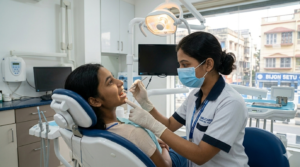
The approach here leans on the same principles covered in this guide: catching problems early, explaining things to both the child and the parent in plain terms, and keeping first visits calm rather than clinical. Whether your child needs a routine checkup, has a tooth that’s been bothering them, or has just had an accident that needs urgent attention, the clinic is set up to handle pediatric cases without the appointment feeling like an ordeal for either of you.
If you’re in Kasba and it’s been a while since your child’s last dental visit, or you’ve noticed one of the warning signs covered above, it’s worth booking a checkup sooner rather than later. Contact The Tusk Dental Clinic to schedule an appointment.
Frequently Asked Questions
At what age should my child visit a pediatric dentist?
By their first birthday, or within six months of their first tooth coming in, whichever comes first. This is the standard recommendation from pediatric dental associations, even though many parents assume visits should start later.
How often should children get dental checkups?
Every six months is the general guideline for most children. Kids with a higher risk of cavities may need to be seen more often, based on what their dentist recommends after assessing their individual risk.
Are cavities in baby teeth really a problem?
Yes. Beyond causing pain and infection, untreated decay in baby teeth can affect the permanent tooth developing underneath and can lead to early tooth loss, which often causes crowding issues later on.
Is pediatric dental treatment painful?
Most routine treatment, cleanings, fluoride application, even fillings, is designed to be as comfortable as possible, and pediatric dentists use techniques and pacing suited to children specifically. Local anesthesia is used where needed, the same as it would be for an adult.
What should I do if my child has a toothache?
Rinse their mouth with warm water, check for any visible swelling or a stuck food particle, and book a dental visit as soon as you can. Avoid placing aspirin directly on the gum or tooth, and use a child-appropriate pain reliever if needed while you wait for the appointment.
Can thumb sucking affect permanent teeth?
It can, particularly if the habit continues past age three or four, and especially if it’s still happening once permanent teeth start erupting around age six. Most children stop on their own well before this becomes a concern.
What should I do if my child knocks out a baby tooth?
Don’t try to put it back in the socket. Control any bleeding with a clean cloth, keep your child calm, and see a dentist the same day to check for damage to the gum or the tooth developing underneath.
Does my child need fluoride treatment?
Most children benefit from fluoride varnish during regular checkups, particularly if they’re prone to cavities. It’s a quick, painless step that strengthens enamel and helps prevent decay.
When should a child get dental sealants?
Typically once the first permanent molars come in, around age six, and again for the second molars around age twelve. Sealants protect the deep grooves in back teeth that are hardest to clean with a toothbrush alone.
Where can I find a pediatric dentist in Kasba?
The Tusk Dental Clinic, located at 44 Rajdanga Main Road, Sector F, Nabapally, Kasba, Kolkata, provides pediatric dental care including checkups, cavity treatment, sealants, and emergency care for children.